Showing posts with label review. Show all posts

Wednesday, 13 April 2016

Pussy Galore: Is is time for a more gender equal Bond franchise?

Ian Flemming’s character James Bond was brought to life in 1962 in ‘Dr No’, but looking back have those fifty-three years changed Bond’s attitudes towards women, or is gender equality on screen still just a Spectre? 

James Bond has been around long enough to see the attitudes towards women change over time: with second wave feminism in the late 1960’s through to the 1980’s. Yet the approach to female characters within the films have arguably stayed the same over the course of fifty-three years and twenty-four films. The term “Bond girls” has become a part of film culture and language since the birth of the Bond film franchise in 1962, but still in 2015 it is clear to see that’s all they are intended to be: James Bond’s girls. We are still yet to see a completely resourceful and empowered “Bond girl” instead of a disposable sex object. As this approach to treating women on screen has been around for so long, is it now seen as excusable within the James Bond franchise because it’s viewed as traditional?

  “To modernise the Bond girl is to deprive Bond of his power.”
‘Spectre’ (2015, Mendes) is the twenty-fourth film in the James Bond franchise and the fourth film featuring Daniel Craig as Bond. Before release Craig publically stated that this film would buck the James Bond trends and introduce a new type of Bond girl for the modern female audience. Lea Seydoux plays Dr Madeleine Swann, she can fight for herself, she knows how to use a gun, and yet she is still the damsel in distress for Bond to rescue and ultimately seduce. Dockterman explored this character and pointed out that the fundamental flaw in the representation of gender equality in Bond is that “to modernise the Bond girl is to deprive Bond of his power. To modernise a Bond girl, she has to embody female empowerment and strength without a man. But since he is our hero, it’s unlikely to see a woman save the day.
Even in ‘Spectre’ Lea Seydoux’s character isn’t the first woman Bond seduces, and yet as the film progresses it’s almost as if it is hinting that this is the woman Bond will finally settle down with: he beds widow Lucia Sciarra, played by Monica Belluci, for information about her husband only a short way into the film. Belluci serves only to move the plot along, however unlike in previous films such as ‘Casino Royale’ (2006, Campbell) she at least escapes with her life. The previous deaths of M (Judi Dench) and Vesper (Eva Green) are shown to be important to Bond, however even those serve as plot devices in ‘Spectre’. Christoph Waltz’ character summed it up perfectly when he asked Bond “Did you think it was a coincidence that all the women in your life end up dead?”

Honor Blackman and Sean Connery in ‘Goldfinger’ (1964, Hamilton)
It is impossible to examine the misogyny in James Bond without looking back to the earlier films. Despite being given a risqué name, Pussy Galore from ‘Goldfinger’ (1964, Hamilton) had the potential to form the first stepping stone to a more equal Bond. Elizabeth Ladenson explored the difference between Galore and the rest of the Bond girls, not only was she a lesbian character but she was a judo expert capable of fighting for herself. Jaime Hovey wrote about the importance of Pussy Galore, and the importance of how Flemming claimed James Bond “cured Pussy Galore of her lesbianism”. Hovey explores a perfectly resourceful woman like Galore, she resembles a more masculine type of femininity – she can fight like Bond can, she can fly a plane, but she’s also attracted to women like Bond is. According to Hovey, by “curing” her lesbianism and seducing Pussy Galore, Bond transforms her from a ‘butch’ to a ‘femme’ which is the familiar stereotype of femininity to us as an audience for a Bond girl.  If Pussy Galore had remained a lesbian character throughout the film, it would have symbolised an incredible amount of female empowerment. By letting her be seduced by Bond she becomes just another Bond girl added to the pile of his past sexual encounters, another woman yet to challenge Bond’s masculinity.
An interesting character to note the development of is Miss Moneypenny. Moneypenny features in more films than any character other than James Bond himself, making her incredibly important when dissecting the franchise from a feminist perspective. Tara Barbrazon described how even though Moneypenny is a central female character, and that Bond talks to her the same way he talks to other women, this “muffled eroticism” formed the longest unconsummated onscreen relationship, and concludes by saying that Moneypenny remains the woman behind the man (M) and the legend (Bond.)
  “If you think for one moment I don’t have the balls to send a man out to die, your instincts are dead wrong.”


Even though she is different to the other female characters, Moneypenny is treated the exact same way – in ‘Dr No’ (1962, Young) Bond goes as far to refer to Moneypenny as ‘government property”, and she’s shown to enjoy his sexual advances even if they never go further. However as of yet, Moneypenny has not been killed or sexually assaulted like many other female characters. ‘Skyfall’ (2012, Mendes) saw a change to Moneypenny with Naomie Harris taking over the role as a field agent who helps Bond on his mission. She proves to be useful on the mission, able to drive and shoot, however she ends up shooting Craig’s Bond, ‘killing him’. Because of this her field agent status is stripped from her, and she reverts back to simply being the ‘sexy secretary’ she always was. At least in ‘Spectre’, Moneypenny is no longer shown to lust after Bond, and has a sex life of her own away from him; however, as Dockterman notes, Moneypenny is relegated to reading out instructions for Bond from behind a desk while he drives his Aston Martin. The character developed and then reverted back to how things were in the 1960’s, with Moneypenny sat at a desk being leered at by Bond.
Notably, there is one exception to the rule that all women in Bond are treated the same. In ‘Goldeneye’ (1995, Campbell) the character of M, Bond’s superior, was recast as Judi Dench. In one of their first scenes together, M briefs Pierce Brosnan’s Bond about finding Goldeneye, and the pair share a bottle of whiskey. Comparable to his interactions with Miss Moneypenny or any of the “Bond Girls”, it’s clear she is demonstrating her power over him, and more importantly that he is aware of it. In their first meeting she refers to him as a “sexist, misogynist dinosaur, a relic of the cold war.” The first time Bond has ever been challenged on his attitudes towards women, and it’s coming from the character who was recast as a woman. This is a defining step for James Bond towards the equality of gender representation, and it comes as late as 1995. During this first briefing with Bond, M even compares herself to a man by saying “If you think for one moment I don’t have the balls to send a man out to die, your instincts are dead wrong.” She’s attacking Bond where it hurts him the most: his masculinity. By comparing her metaphorical testicles to his, she emasculates him in one short sentence.
“Attitudes towards women in the world have changed since the 1960’s, so why not in Bond?”
 However, as McNeely commented in his essay ‘The Feminization of M’, there are inconsistencies in the way Dench’s character addresses Bond’s misogyny throughout the franchise. McNeely shows how after emasculating Bond in ‘Goldeneye’, she goes on to join in with his flirtation and use of double entendre in ‘Tomorrow Never Dies’ (1997), and even hires Miranda Frost to seduce Bond in ‘Die Another Day’ (2002). With Daniel Craig becoming the new Bond, M’s defining femininity becomes that of the mother, with Bond sarcastically calling her “mum” often. This maternal femininity is often shown in female characters that aren’t shown to be sexual, as opposed to the other prominent female stereotype of the “femme fatale” which is attributed to Bond girls. Ultimately it’s clear that M’s shifting values demonstrate how those behind Bond tried to change their attitudes towards women within the franchise, but gave up and reverted back to conforming to the gender stereotypes that worked so well for them in the past.
Toby Miller in his essay ‘James Bond’s Penis’ examines the franchise as both a contribution to, and symptom of sexism, and compares it to pornography. Clearly the misogyny in 21st Century Bond isn’t as harmful as that of the 1960’s and 70’s, however attitudes towards women in the world have changed since then, so why not in Bond? Prejudice towards women before the beginning and throughout second wave feminism reflected in women’s on-screen representation. So there is nothing that gives the recent James Bond films the excuse to reflect these now seemingly prehistoric portrayals of women as simply sex objects, other than regarding Bond’s treatment of women as ‘traditional’ of that of the franchise as he has been doing it for so long. If that is so, the image Bond is producing for young boys and men to watch is that treating women like this is acceptable, and even by oppressing women in such a way they still ultimately fall for him.
  “Bond reflects modern attitudes towards women in cinema.”

However, these gender stereotypes are no longer the popular opinion amongst Bond’s audience. In 2015, former Labour party leader Ed Milliband said it was time for a female James Bond and criticised the film’s representation of women, a comment that provoked Martin Daubney to respond that “if the easily offended got their way, they would drain the lifeblood from cinema” and accused the “radical feministas” who disagree with the presentation of women in James Bond of wanting to “neuter every Alpha male in popular entertainment.” This comment from Daubney is evidence enough that James Bond is still stuck in the 1960’s, but people accept that as a British tradition. This shows that misogyny is deemed apparently acceptable in “Alpha male” characters, as that is simply just a trope of their character and part of the “lifeblood” of the modern film industry.
This claim of misogyny as the “lifeblood” of cinema is backed up by statistics released by Women Make Movies, an organisation founded thirty years ago to spread the word of female misrepresentation in cinema. WMM reported that only 11% of all clearly identifiable protagonists are female, with 78% being male.  They also go on to compare how in the highest rated 500 films, 28.8% of women are shown as sexually revealing with 26.2% female actors getting partially naked on screen. There is also still a lack of women behind the camera in modern cinema, with only 1.9% of directors being female. These statistics point to the dark truth that James Bond reflects not only the 1960’s attitudes towards women domestically, but the modern attitudes towards women in cinema.


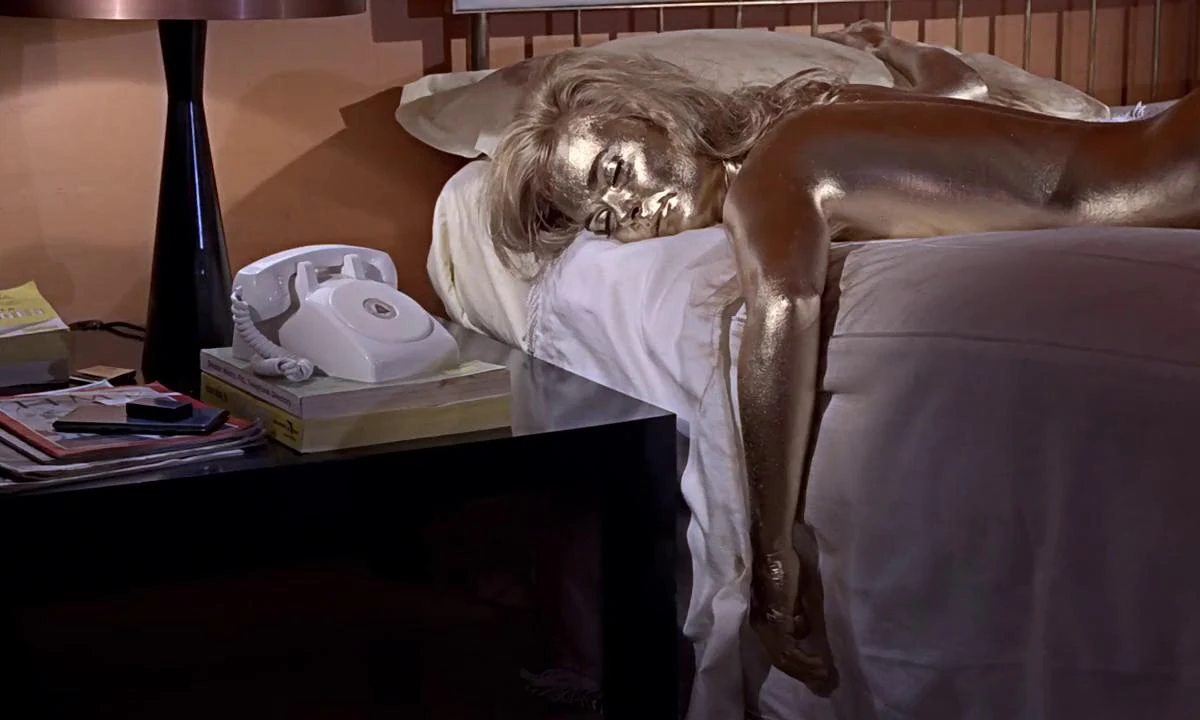
Shirely Eaton – dead, nude and painted gold in ‘Goldfinger’
In summary, as enjoyable as the James Bond franchise is to many people for its cinematography, gadgets and fast cars, under the surface the representation of Bond girls gives a window into the truth about the prejudice towards women in cinema. Not only are the women in Bond films shown as disposable, usually dying as a result of James Bond having sex with them, they only exist to move the plot along and to give the male audience something to look at. This concept is the famous feminist film theory of the ‘Male gaze’ coined by Laura Mulvey; if the Bond girls were taken out of the film entirely it would just be a regular spy film, by adding them in it creates excitement and seduction for the male audience. The lack of power that the Bond girls have reflects the lack of female empowerment of all women in the film industry: surely it is about time for the world to be ready for a more gender equal cinema.


Friday, 22 January 2016

'Making A Murderer' Series Review: SPOILERS


I binge-watched all 10 hours of Netflix's new true crime documentary series 'Making A Murderer' in the space of two days, and it was the best decision I'd ever made. Filmed over the course of 10 years, the series follows the life of Steven Avery and his family after he was wrongfully imprisoned for 18 years for a rape he didn't commit. After he was released he sued the Manitowoc sheriff's department for the 18 years of life he lost behind bars, and while preparations for $36million civil suit were under way with help from The Innocence Project he was arrested charged with the murder of Teresa Halbach, a photographer who was apparently last seen on the Avery property.

Over the course of the 10 hours of courtroom footage, interrogations and interviews with Steven and his family your opinion on his innocence will shift back and forth as more evidence is revealed. Avery and his defence attorneys were accusing the Manitowoc sheriff's department for framing Avery and planting evidence on his property; they were told to stay out of the investigation and let neighbouring Calumet county take care of it instead, and yet the Manitowoc detectives still found their way into the crime scene the day the evidence against Avery was found.

There are two instances while watching 'Making A Murderer' where you will openly gasp in shock and clearly count as evidence against the Manitowoc sheriff's department: one is that a vial of Avery's blood had been tampered with in the evidence room, and a small hole was found in the top that looks like someone who had access to the evidence had extracted his blood to plant in the crime scene. And the other is a telephone call from Sergeant Andrew Colborn who had called in the number plate of Teresa Halbach's Toyota RAV 4 three days before it was found on the Avery property, while doing so he read out the plate and asked the operator if it matched to a '1999 Toyota', something only someone who was reading the plate from the back of the car would have known. This suggests that Colborn had been looking at the victim's car three days before it was found by the authorities on Avery's scrap yard. Ultimately Steven Avery and his nephew Brendan Dassey - 16 years old - were sentenced to life imprisonment for second degree murder, mutilation of a corpse and sexual assault. The charge of false imprisonment against both defendants was later dropped during the trial.

Overall, 'Making A Murderer' has caused quite the stir. It's had an amazing online response from people who want to make it known that Steven Avery is clearly innocent. Even a letter was written to the White House asking for him to be released, to which unfortunately Obama declined. It is such a rare and wonderful thing for a documentary film or series to have such an effect on people, the only other documentary that I can recall having a similar effect was 'Blackfish', which is still used today against Seaworld and has contributed to parks having to alter their treatment of their captive performing orcas by law.

Rating: 10/10 - I would definitely recommend watching if you enjoy true crime stories and have 10 hours to spare and are in need of a new and interesting series to watch!


Thursday, 17 December 2015

STAR WARS MEGA-REVIEW


December 17th 2015, or as it is now known, Star Wars Day. Luckily I got to see it at the midnight premier last night, because if I'd had to have waited any longer to see it, I would have literally burst.
With that in mind, I wanted to do something Star Warsy today as a tribute to one of the biggest and greatest movie franchises, but I don't want to spoil anything for anyone - because there are people who will have waited since 1984 to find out what happens to Luke, Leia and The Gang. So I'm going to review all of the other six Star Wars films in one mega-post,with a teensy footnote about The Force Awakens with no spoilers, therefore only spoiling things for people who have never seen any Star Wars before; and if you're one of them, it's been 30 years, you can't expect us to not post Empire spoilers any more...

Oh, and to make it even more exciting, I'll be reviewing them in the order that I watched them. Or rather, the order I was shown them in the first time, which incidentally is the wrong order. And to top it all off, I'll tell you people who have never seen it, what the right order is.

A whole lotta spacey stuff to get through... But we'll manage. Here is what I have to say on each Star Wars movie in the order that I first saw them.

Episode IV: A New Hope


I did this part right. The first Star Wars film I ever saw was the first Star Wars film period, in fact when it was originally released it wasn't called Episode IV: A New Hope, it was just called Star Wars. This is the original, the film the people in the 1970's started with, and the place where you definitely should start. Unless someone is super into the prequels, they'll always tell you to start at Episode IV. Despite that, this is the Episode that I have seen the least of (disregarding the prequels, obviously.) I've only seen A New Hope twice, years ago. I struggled to follow it the first time because I didn't know anything about the Star Wars universe, and it starts off quite slow - which is the main argument for watching the prequels first. But you meet Luke Skywalker, which is where the story definitely should start. Starting with Episode IV you get to see Darth Vader as everyone in 1977 did, as the scariest and most evil man in the galaxy. If you start with the prequels, he just doesn't have the same effect. 

However, and I will stress this with all of the original trilogy films. If you have never seen this film before, try TRY to search for the original version, not the one that George Lucas went back and screwed with beyond repair. Watch the original and then, if you want, watch the super CGI'd edited version. But you'll thank me for telling you this. Overall I will rank A New Hope as my third favourite Star Wars films out of all 7. It may seem slow to Star Wars virgins but I promise that if you manage to get invested in it you will absolutely adore Episodes V and VI.

Episode I: The Phantom Menace.


Yup. This is where I messed up. I did warn you that the first time I watched the saga I did it wrong. But I can explain. The reason why I followed one of the best Star Wars films with the absolute worst one, is that I was dating a guy who truly believed the prequels were better, and was therefore angry that I'd started Star Wars from the actual beginning, instead of the fake beginning. 

According to the Machete Order you're meant to skip this one completely. Watch all the others, and then come back to this one at the end if you really want to. But it genuinely adds nothing to the story, and you can easily live having never seen it. Anakin as an 8 year old boy is completely pointless, he's not even a Jedi at this point, he's just a kid. At least Episodes II and III show SOME character development (and I use that phrase lightly.)

My problem with the prequels as a whole is that when I first watched them all I was 19, unlike everyone else my age who saw the prequels in the cinema when they were kids. Meaning that unless you've gone back and re-watched them all, you probably have quite fond memories of them. But being 19 and watching the prequels means I was at an age where I was trying to understand all the council meetings and the trade federation and midichlorians, and I lost interest very quickly because it was so hard to follow and so needlessly complicated and boring. However, kids will have liked it - they probably will zone out in all the political parts, but the pod race is kind of cool... I guess? Overall, this is right at the bottom as number 7. Don't watch this film unless you really REALLY want to, and even then, try and change your mind.

Episode II: Attack of the Clones
More prequel tosh next. Episode II takes place 10 years after The Phantom Menace, again, highlighting how much we didn't need that film in the slightest because now Anakin is a whole new character. He's 18, he's a Jedi apprentice, and we could easily have just started here. So, if you do insist on watching the prequels first like the odd minority do, start here. Please?

George Lucas says that Episode II is "ultimately a love story", which would translate if the two actors had any on screen chemistry at all, and if the romance wasn't so forced. Other than the love story that is just shoe-horned in there is nothing else I can say about this movie that I didn't say about Episode I. I actually fell asleep towards the end of this film and then gave up with the prequels entirely until after I'd finished the original trilogy. Episode II comes in at number 6.

Episode V: Empire Strikes Back

Finally we've reached Empire, everyone's favourite. The best Star Wars film, one of the best films ever made. I got bored of the prequels and went back to the original trilogy. Whether you follow either the Machete order or the release order, Empire follows A New Hope. It just makes sense, and it allows the story to progress in the best way possible following the destruction of the Death Star. And also, other than in Episodes IV and VI, the special addition changes aren't all that bad in comparison, so watching either versions will still make it your favourite. 

We get to see Luke Skywalker using The Force, we get to see Yoda training him to be a Jedi, Han Solo and Leia's relationship develops, which unlike the prequels is a real love story that people enjoyed watching and Darth Vader is tracking Luke down with a vengeance after the Death Star. Most importantly, we see them fight against each other for the big reveal that - yup - Darth Vader is Luke's father. The film ends with nothing going right for anyone except the Empire, it's the perfect cliffhanger to leave on for Episode VI, and I wish I'd have been able to see it without knowing the big secret. Obviously The Empire Strikes Back is my number 1 favourite Star Wars film.

Episode VI: Return of the Jedi
Personally my least favourite of the original trilogy, but that is probably down to it having such a hard time following Empire Strikes Back. This was also the worst re-edited film, I was lucky enough to never see George Lucas' strange new creation, but I've heard it is the main reason why this film gets such a bad rep. 

Luke Skywalker is a whole new character in this film, he's transformed into a true Jedi and he really is finally at one with The Force, and it's revealed that him and Leia are brother and sister - which we all knew already anyway, but still awesome. Leia is shown to be force-sensitive too, which would make sense as it runs in the family, she tells Luke that she always knew that they were siblings - and I've always really liked that even though she is susceptible to The Force she never actually uses it to the extent that Luke or Vader do, even in The Force Awakens. 

There has been some dispute about the order that you are meant to watch Return of the Jedi in. Most people will watch the films in release order which means Episodes IV-VI followed by the prequels, but the Machete order is Episodes IV and V followed by watching II and III as a flashback, and then finishing with VI. I personally have never seen the appeal of watching the prequels as a flashback in the middle of the original trilogy for your first viewing, for people who don't understand the universe of Star Wars I wouldn't recommend the Machete order. But if you've seen them all already then definitely try it. Overall Return of the Jedi comes in as my fourth favourite. I don't like it as much as the other original films, but it still beats the prequels hands down.

Episode III: Revenge of the Sith

So after giving up on the prequels after the piss poor attempt George Lucas made with Episodes I and II, I attempted Revenge of the Sith after I'd seen and been able to appreciate the three genuinely good movies without Lucas taking a massive crap over my whole Star Wars experience. By default this is the best film in the prequels, but that doesn't mean it's good. Like, at all.

The one good thing this movie does is show the transformation from Anakin Skywalker into Darth Vader, in the space of less than 10 minutes Skywalker abandons his Jedi teachings and becomes a child murdering Sith Lord. You hear Darth Vader's theme play for the first time and it did send a few shivers down my spine because this guy is truly evil. However, George Lucas also didn't learn that kids don't give a damn about government meetings, even at 19 seeing this film for the first time - as with the other prequels - I zoned out completely.

The romance is still there, shoe-horned in and still as awkward as ever. And Padme, who I thought would be a pretty cool character at first, ends up dying of a broken heart..? And the scene where she gives birth is just so poorly written and poorly acted out. I was so bitterly disappointed with the ending other than seeing Vader's suit for the first time. And even that was ruined by THAT moment that still haunts Star Wars fans to this day. You'll know what it is...

Revenge of the Sith is my fifth favourite Star Wars film, better than the other two prequels but nowhere near the original trilogy's standards.

And finally, that leaves us with Episode VII: The Force Awakens
I promised you that I wasn't going to give anything away about this film, so this will be short and sweet and I hope those of you who are yet to watch it really enjoy it. The acting is fantastic, including all the older stars (I was concerned that poor old Carrie Fisher wouldn't be able to hack it, but she did fabulously) and Finn and Wrey are both amazing, the perfect Star Wars heroes for the new generation. The humour is on point, and so nostalgic of the original trilogy, not the awkward jokes George Lucas added to the prequels that simply never landed. I thought at first that it was purely a film that existed for fan service alone but now I love it, I'm seeing it again in a few days and I can't wait. Everything is nostalgic of the films of the 70's and 80's but that is what is so amazing, it's not a cheap trick or laziness, it's a perfect homage paid to Empire Strikes Back. Also Kylo Ren is scary as hell. 

I've given The Force Awakens an 8/10, that might change after seeing it again, but I really enjoyed it. It was hard to live up to everyone's expectations and I think it did better than we thought it would. And that is why I'm listing it as my second favourite Star Wars movie, after Empire.


Monday, 14 December 2015

SPECTRE: Film Review SPOILER-FREE


IMDB synopsis: A cryptic message from Bond's past sends him on a trail to uncover a sinister organization. While M battles political forces to keep the secret service alive, Bond peels back the layers of deceit to reveal the terrible truth behind SPECTRE.

Every review possible for this film is going to say the exact same thing, but I'm going to say it anyway because it's worth mentioning: the opening tracking shot in this film is amazing. It was beautiful, and was crafted and used perfectly. From that I was surprised, I was going into watching this film sceptical after the success of Daniel Craig's earlier Skyfall, there was no way it wouldn't pale in comparison. And from that opening tracking shot onwards, I was right.

I always look forward to the title sequences of James Bond films, naked silhouettes aside (which is a topic for another day) they're always so well executed and even though the style has changed through the years they all have the same feel to them. This one was no different, however Sam Smith's song just didn't fit as well as Adele's Skyfall. I think the people at Bond HQ knew that too, it wasn't advertised nearly as much as Adele's was, or Skyfall as a film in general. It's as if they knew no one would prefer Spectre.

On the whole, Spectre was a gigantic waste. A waste of beautiful cinematography, a waste of what we're told will be Daniel Craig's last Bond film, and a waste of a good villain. Seriously, who has Christoph Waltz in their film and only uses him for three scenes? He is an amazing actor, one of the best villains in the industry, and the character had the potential to be interesting enough - but there just wasn't enough of him! And we had to wait until the last act of the film to even see him, and understand his evil plan. Bond villains are always some of the best, and this just didn't cut it.

On top of all of that, and I hate to say this, the film dragged. I actually checked my watch during it - which I haven't done during a film since Jurassic World. I was bitterly disappointed, but I think that is just down to the amazing standards set by Skyfall and Casino Royale.

At least it was better than Quantum of Solace... I give it a 5/10.

Click on Dan the Hunk to watch the trailer!


Wednesday, 4 November 2015

Twelve Twenty Three

Cinematography in my latest short film “Twelve, Twenty Three.”


"The last thing I saw was my alarm clock flashing 12:23 before she pushed her long rotting nails through my chest, her other hand muffling my screams. I sat bolt upright, relieved it was only a dream, but as I saw my alarm clock read 12:22, I heard my closet door creak open."


The story for Twelve Twenty Three came from a series of two sentence horror stories posted on Buzzfeed. We decided to use this incredibly short story because it gave us an interesting narrative idea, yet it left us a lot of room to expand. To make the narrative flow better on screen, I decided to show time passing throughout the day leading up to the male character's death, and this is shown through the use of a flashback. The watch is shown in multiple shots to show how time has passed. Throughout the day he notices a few suspicious things, foreshadowing the event that the viewer already knows is coming. 

"In 'Friday the Thirteenth' and 'Halloween' the director uses a subjective camera in the stabbing scenes, which, essentially, makes the viewer the killer. The camera moves in on the screaming, pleading victim."
I took inspiration from these scenes in 'Friday the Thirteenth' and 'Halloween' for the shot of the male character in the bed when the female antagonist appears. The use of a shot from his POV as she slowly moves towards him like a shadow again subverts the horror genre gender stereotypes. 

^ click me  to watch!^


Copyright © 2014 Emily Rose